Five Things To Know Before Buying Art for the First Time
Updated: Sep 16
Why Buying Art Feels Overwhelming (It Really Doesn’t Have to Be)

If you’ve ever stood in a gallery feeling out of your depth, or spent twenty minutes on an artist’s website only to close the tab without buying anything, you’re not alone. First-time buyers often describe a particular kind of paralysis: drawn to something, unsure whether to trust it, worried they’re missing some knowledge that everyone else seems to have.
Here’s the thing: they’re not. There is no secret. Deciding to buy original artwork for the first time is less about expertise and more about learning to trust what you already feel.
Five Things To Know Before Buying Art
These five things will hopefully make the decision feel a great deal less daunting.
1. You Don’t Need to Be an Expert
The art world can feel like it has its own language, its own rules, its own hierarchy. It doesn’t, really, or at least none of that should to concern you when you’re buying something to live with in your own home.
What matters is personal taste, not art history. You don’t need to know the difference between movements or be able to place a work in its critical context. What you need to know is whether something stops you. Whether you come back to it. Whether you can imagine it on your wall six months from now and still feel glad it’s there.
The artists whose work resonates with people (whether that’s a Scottish artist painting landscapes, a ceramicist making small functional objects, a printmaker working in two colours), these are often the ones who make work from a genuine place. You don’t need credentials or letters after your name to make something that people respond to.
2. Original Artwork Is Different to Prints
This is worth understanding before you buy anything. A print and an original painting might look similar in a photograph, but they feel entirely different in a room.
An original has physical presence: texture, depth, the trace of decisions made in real time. Paint that’s thick where the artist pressed hard, thin where they held back. A surface that catches the light differently depending on where you stand. You’re aware, in a way that’s hard to articulate, that the thing in front of you was made by a person, not reproduced.
When you buy original artwork, you’re also buying something singular. There is no other one.
That changes how you relate to it, and it changes how the work sits in a space. Browse any collection of Scottish art for sale and you’ll find a range of sizes and prices: original doesn’t have to mean expensive, and it never means ordinary.

3. Think About How It Will Feel in Your Space
Not how it will match. How it will feel.
Colour-matching art to a sofa is the fastest way to end up with something forgettable. What’s more useful is thinking about the mood of the room: is it a space where you want to feel calm, energised, reflective? Do you want a piece that anchors the room quietly, or one that demands attention?
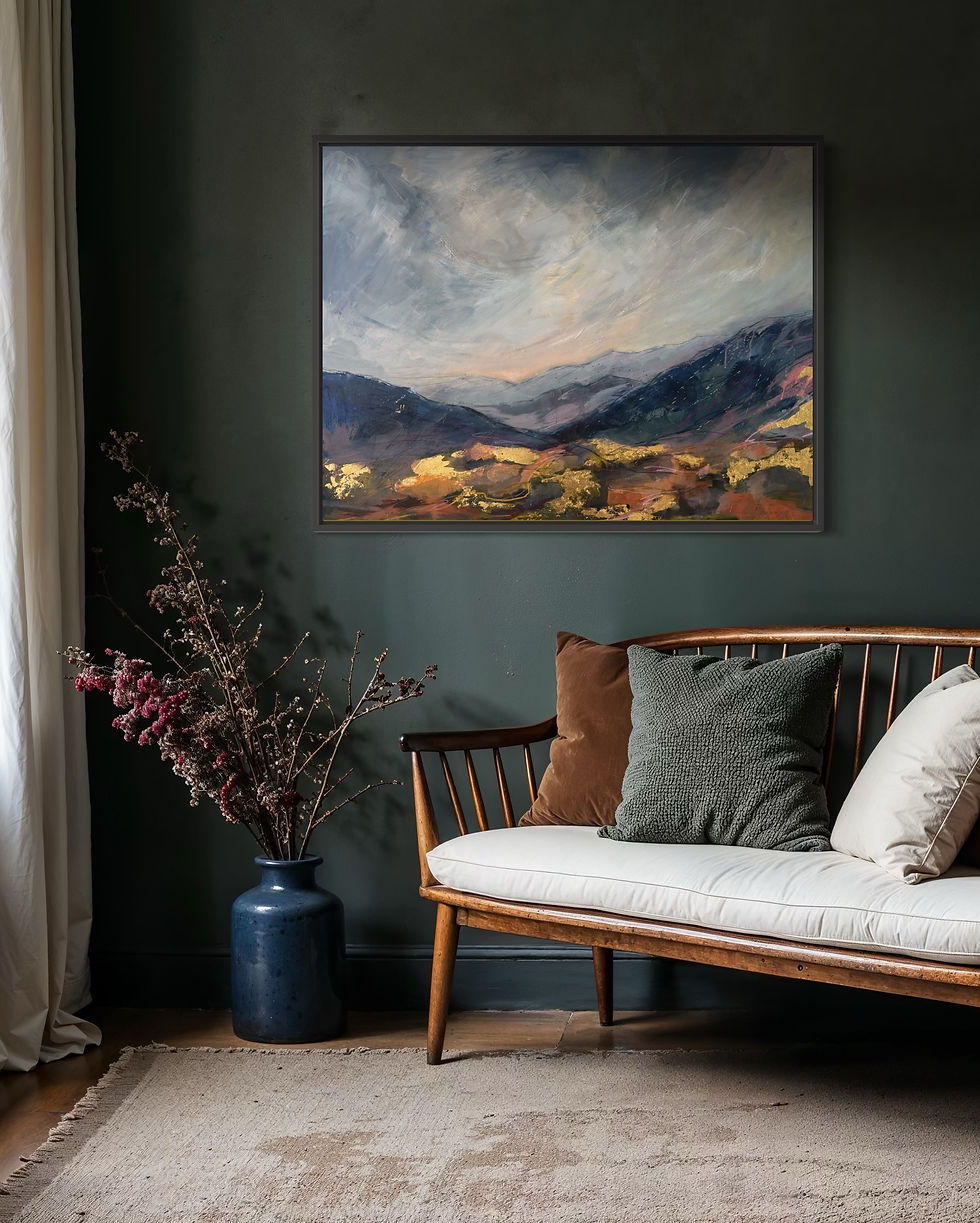
Scottish landscape paintings work particularly well in spaces where people want a sense of light and distance: a living room that needs to feel larger, a bedroom that should feel restful, a hallway that welcomes you home. The colours in a well-chosen landscape can do a great deal of emotional work without ever feeling intrusive.
Think about living with the piece daily, at different times of day and in different lights. That’s the real test.
4. Size and Placement Matter More Than You Think
One of the most common mistakes first-time buyers make is choosing something too small. A painting that feels significant in a studio or on a screen can disappear on a large wall. Art that’s undersized for its space tends to look provisional, like a placeholder rather than a choice.
If you’re looking at landscape paintings for sale and you’re not sure what size to go for, err slightly larger than your instinct tells you. A piece with scale can anchor a room entirely on its own. Smaller works are lovely too, but they tend to work best grouped, or in more intimate spaces: a reading corner, a narrow wall, a shelf.
The question to ask isn’t just what fits. It’s what the room needs, and what you want.
5. Buy Something That Lasts Beyond Trends
Interior trends move quickly. What feels current this year can feel dated in three. Art that was chosen to match a trend tends to age with it.
The pieces that stay with people longest are almost never the trendiest ones. They’re the ones that were chosen for a less rational reason: something in the colour that felt instinctively right, a sense of place that resonated, a mood that the buyer couldn’t quite name but recognised.
Scottish landscape paintings have an enduring quality for exactly this reason. The landscapes themselves don’t date. The light on a Perthshire hillside in October, the particular blue of a west coast bay: these things outlast any colour palette trend, because they’re connected to something real and specific and lasting.

Buying Directly From an Artist
There’s a particular kind of conversation that becomes possible when you buy directly. You can ask what the painting is about, what the place is, what the artist was trying to hold on to. You find out whether the work was difficult or came easily, what was reworked, what was resolved in a single session.
That context becomes part of how you experience the work. It doesn’t change what’s on the canvas, but it deepens it. When you buy Scottish art for sale directly from a Scottish artist, you’re also doing something straightforward and meaningful: supporting someone who makes their living from this, rather than a third party who doesn’t.
Taking the First Step Without Overthinking
The most practical advice is also the simplest: if a piece stays with you after you’ve looked away, go back to it.
If you’re uncertain about scale or budget, start with something smaller. There’s no rule that says your first piece of original artwork has to be a statement painting. A small work that genuinely moves you is worth infinitely more than a large one bought out of obligation.
And if you keep returning to the same image, the same palette, the same feeling: that’s not indecision. That’s instinct telling you something worth listening to.
Your First Piece Just Needs to Feel Right
You don’t need to get it perfect. You just need to choose something you genuinely connect with, something you’ll want to look at tomorrow and next year and in a decade.
Explore the collection of Scottish landscape paintings and find a piece that feels like it belongs in your space. Or get in touch if you’d like to talk about a commission inspired by a place that means something to you.
FAQs
Is buying art for the first time expensive?
Not necessarily. Many artists offer a range of sizes and price points, and an original work at a modest scale can be far more affordable than people expect.
How do I know if I’ve chosen the right piece?
If you feel drawn to it and can imagine living with it every day, that’s a good enough reason. There’s no more objective test than that.
Should I buy prints or original artwork?
Both have their place, but original artwork offers something a print can’t replicate: physical presence, uniqueness, and a direct connection to the person who made it