How To Hang and Live With Original Art in Your Home
There’s a moment that can happen after someone has bought an original artwork that they’ve completely fallen in love with that they think “where on earth am I going to hang that…?” I want to reassure you that this moment passes. What replaces it, is something even better: a painting becoming part of daily life in a way that a print or a piece of decorative art rarely does.

Original art isn’t just something you hang. It’s something that becomes part of your home and family’s lives . And how you approach that makes all the difference.
Choosing the right wall and placement
If you haven’t yet bought the painting, begin by focussing your attention on the room you’ve earmarked as needing new artwork. Where does your eye naturally go when you walk in? That focal point (the wall above a sofa, the space at the end of a hallway, the area you face from your favourite chair) is usually where a painting will have the most impact.
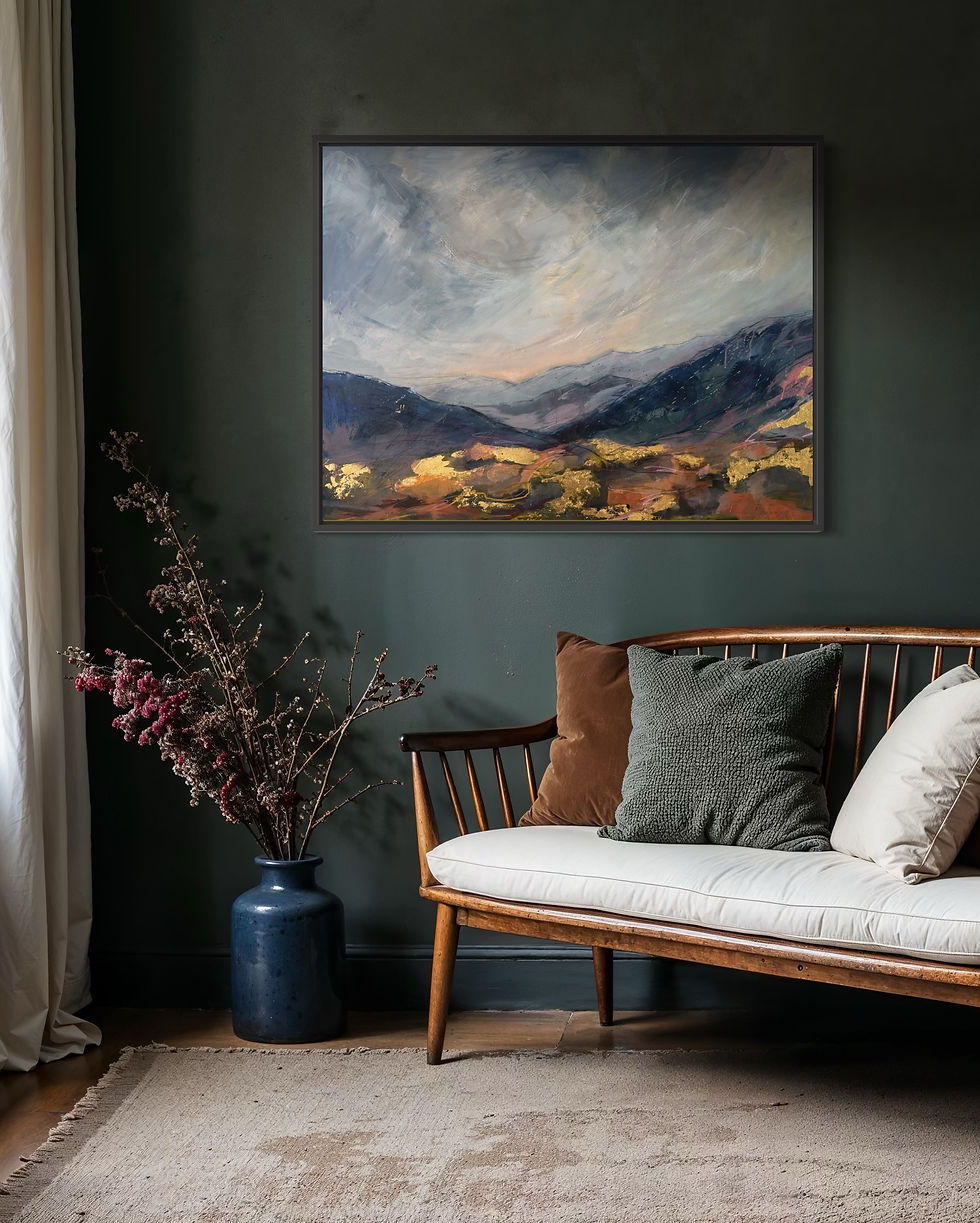
Eye level is the standard rule for good reason: it puts the artwork in your natural field of vision rather than making you look up or down to engage with it. In practice, that means the centre of the painting sitting at around 145 to 150 centimetres from the floor, though this shifts depending on your furniture. A painting hung above a sofa should sit comfortably above it without floating away from it, roughly 15-20 centimetres of space between the top of the sofa and the bottom of the frame works well.
When you’re browsing landscape paintings for sale, it’s worth thinking about which wall you have in mind before you buy, not after. A wide horizontal piece and a tall narrow one will each suit a very different space.
Getting the scale right
This is where most people go wrong: they choose something too small. A smaller painting on a large wall can look tentative, as if the room doesn’t quite believe in itself. In general, err towards something slightly larger than you think you need. You can always adjust the space around it; you can’t make a painting bigger.
A single statement piece, something that holds a wall on its own, will often do more for a room than several smaller works arranged together. That said, a considered grouping of smaller paintings can work beautifully if the pieces share a palette or cohesive framing and the spacing between them is kept consistent.
The relationship between the artwork and the furniture beneath it matters too. A painting should feel connected to what’s below it, not marooned above it. As a rough guide, the artwork should cover around two thirds of the width of the furniture it sits above.

Working with light
Light transforms a painting throughout the day, and this is one of the genuine pleasures of living with original artwork. A canvas with texture catches morning light differently from afternoon light. Colours shift. Details that were quiet at noon become prominent by evening.
Natural light is your ally. A bright room with indirect light is ideal. If you want to add artificial light, picture lights or directional spotlights can pick out texture and add warmth, particularly useful in rooms that don’t get much natural light.
When you buy original artwork, you’re buying something that responds to its environment. Pay attention to how the light moves through the room across the day before you decide on the final position.

Living with art: letting it settle into your space
A painting often takes a little time to become yours. In the first days you’ll notice it constantly. After a few weeks, it starts to belong to the room. After a few months, you’ll find yourself looking at it differently, catching details you missed before, noticing how it shifts in different seasons.
That evolution is part of what makes original work from a Scottish artist so different from a reproduction. There’s depth to return to. A landscape painting made from real observation carries something that reveals itself gradually rather than all at once.
The best rooms I’ve seen with art in them don’t feel curated. The painting contributes to the atmosphere of the space without shouting for attention. Let it do that and don’t get hung up on everything “matching”: furniture, soft furnishings and artwork need to have quiet conversations with one another (an echo of a blue sky in the pattern of a throw, the same purple field in a vase) not be slavishly identical to one or two colours.
Styling around your artwork (not the other way around)
Once a painting is hung, let it lead. This is the advice that runs counter to a lot of interior design instinct, which tends towards matching and coordinating. But original art, rather than a decorative print, deserves to set the tone rather than follow it.
That doesn’t mean your room needs to match the painting’s palette. It means the space around it should be relatively calm: neutral or complementary tones, minimal clutter on nearby surfaces, nothing competing directly for attention. A landscape painting with strong colour will carry a room more easily if the surrounding furniture and accessories are quieter.
A little contrast, a little tension between the work and the space, is where things get interesting.

Caring for original artwork
Original paintings are more robust than people often assume, but a few straightforward habits will help them stay in good condition. Dust gently with a dry, soft cloth if needed, avoid anything damp or chemical near the surface. Keep paintings away from sources of heat and humidity where you can: above radiators and in bathrooms are the two most common mistakes.
Make sure the hanging is secure, properly fix a picture hook or wall anchor for the weight of the piece. D-rings and picture wire are generally more stable than a single hook in the centre.
If you’re ever in doubt about condition, a reputable framer can advise.
Building confidence in your space
There is no perfect placement. There’s only what feels right in your home, with your light, with the rest of what you’ve put in the room. If something isn’t working after a few weeks, move it. Paintings don’t have to be permanent fixtures, they can travel around a home, and sometimes a piece that felt wrong in one room will feel exactly right somewhere else.

Trust your instinct more than the rules. The rules are useful starting points, but you’re the one who lives there. If a painting makes you feel something when you look at it, a sense of calm, recognition, pleasure, then it’s in the right place.
The way you hang and live with art shapes how it becomes part of your home and your daily life. It’s not a one-time decision. It’s an ongoing relationship, and that’s exactly as it should be.
Explore Susie Collingbourne’s Scottish landscape paintings and find a piece that brings presence and balance to your space.
FAQ
What height should artwork be hung at?
Generally, artwork should be hung at eye level; the centre of the painting at around 145 to 150 centimetres from the floor. This can vary depending on furniture and room layout, so use the rule as a starting point rather than a rigid measurement.
Can original artwork be hung in bright rooms?
Yes, bright rooms are often ideal. Just avoid direct sunlight where possible, as UV exposure can affect colours over time. Indirect natural light is one of the best ways to show a painting at its best.
How do I make art feel part of my home?
Give it space, allow it time to become familiar, and let it influence the feel of the room rather than forcing it to match everything else. The longer you live with a piece, the more it becomes yours.